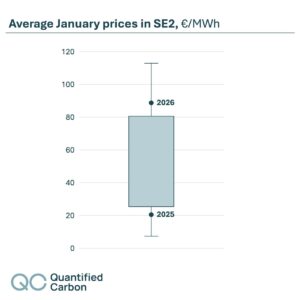
The year 2025 offered exceptionally low electricity prices in northern Sweden, with SE1 and SE2 averaging around 16€/MWh for the whole year. In January, the average price was 21€/MWh. Many power producers in the region were rightfully worried about future profitability.
However, as we pointed out during discussions last year, the very low prices were a result of weather conditions, the hydrological situation and transmission availability. The low prices did not represent a “new normal”. Statistically, the prices over the full year of 2025 roughly represented a 1/10-year event.
In contrast to 2025, the start of 2026 has given us a taste of the other end of the probability distribution. For January 2026, prices in SE1 and SE2 have surged to 88€/MWh on average. This is significantly above the median line, despite drivers such as electricity consumption, gas-prices and CO2-prices being roughly the same as for 2025. The main reason is weather this time as well, but pushing in the opposite direction. The outcomes of January 2025 and 2026 are compared in the figure to a model of the current power system for a January month and varying the weather statistically using 33 weather years.
The key take away is that extreme prices, in either direction, should not be seen as an indication of a new normal. The new normal is rather the high volatility where we should expect prices to differ by a factor 4 to 5 from one year to another.