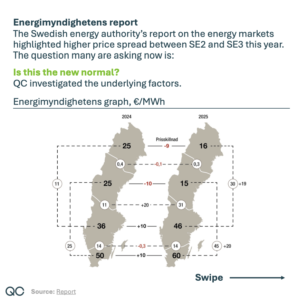
For those interested in the electricity market, 2024 and 2025 have been unusual years in many ways, as highlighted in a recent report by Energimyndigheten. We have seen very large price differences between northern and southern Sweden. During the first half of 2024 we saw relatively normal prices in entire Sweden, i.e. slightly higher prices during the winter, which then fell during the summer.
The extreme behaviour began mainly during the autumn of 2024 and has continued throughout almost all of 2025. What happened was that prices rose as usual in SE3 after the summer 2024, but remained low in northern Sweden, and have stayed low up until October 2025. The main explanation for the large price differences that built up between northern and southern Sweden from autumn 2024 and onwards is a combination of three factors.
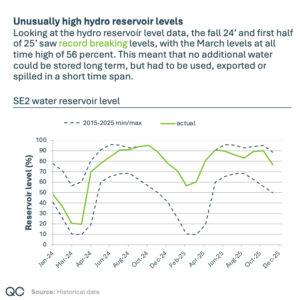
1. 2025 began with very high levels in the hydroelectric reservoirs. This by itself does not necessarily result in low prices, but it means that energy cannot be stored in the reservoirs in the long term. This applies to both hydro inflows and wind power production.
2. Both 2024 and 2025 have been wet years. Not extremely wet, but they have had more rainfall than average. This means that more energy than normal had to be exported.
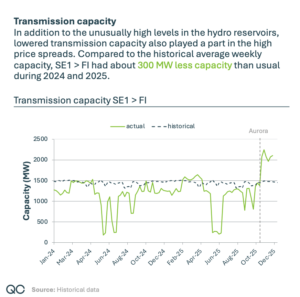
3. Transmission, i.e. export capacity, from northern Sweden to Finland has been more limited than usual.
Together, these three factors create something of a perfect storm for electricity prices in northern Sweden, as the energy supplied to the system cannot be stored, consumed locally or exported south. The result is that it has to be wasted, leading to a collapse in prices. For long periods, the prices have been almost zero, with only a few peaks due to temporary price coupling to the continent.
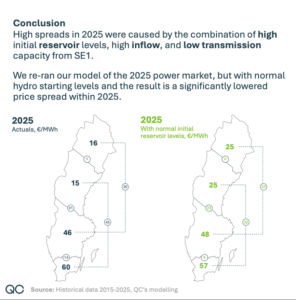
The question many are now asking is whether this is the ‘new normal’. Should we expect such low prices going forward? The answer is probably no. Rather, we conclude that the system today is more sensitive to disruptions of the kind that occurred in 2024 and 2025. Using our electricity market model, we have examined what the developments over the past two years would have looked like if these three factors had not coincided. The results show that we would still have had a significant price spread between northern and southern Sweden, but it would have been reduced by approximately €10/MWh.